
rediffGURU Patrick D'souza, CAT expert and founder of Patrick100 explains how to pick a management course and college that will boost your career.

'The bigger unknown remains global geopolitics, which is inherently unpredictable, including developments in our neighbourhood.' 'Another concern is the increasing tilt of government finances towards welfare subsidies, especially at the state level.' 'This could constrain capital expenditure, which is critical for long-term growth.'
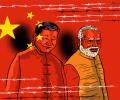
India's trade deficit with China is expected to reach $106 billion in 2025 as imports are rising faster than the country's exports to the neighbouring country, think tank GTRI said on Friday.
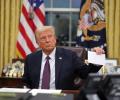
President Trump announces 100% tariffs on movies made outside the US, potentially impacting the Indian film industry. The move follows similar tariffs on pharmaceutical products.

Around 73 per cent of employers interviewed intend to hire freshers during January-June 2026, with recruitment decisions mainly driven by internships and real-world project experience rather than academic credentials alone, a report said on Wednesday. Nearly 3 in 4 employers (73 per cent) intend to hire freshers during January-June this year, marking a 3 per cent increase over the previous half-year, according to TeamLease EdTech Career Outlook Report HY1 2026.

Iran is fighting a different war: Older, slower, and in some ways more dangerous. Iran doesn't need to shoot down an F/A-18. It only needs to make the Strait of Hormuz feel dangerous long enough for insurance markets, shipping companies, and oil futures traders to do the rest. Prem Panicker continues his must-read daily blog on the war in the Middle East.

The ruling is expected to have wide-ranging consequences for global trade, businesses, consumers, inflation trends and household finances across the country.
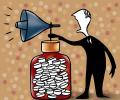
The government should take measures to promote innovation and R&D while simplifying regulations for the sector in the upcoming Union Budget, as per pharmaceutical industry bodies. Outlining the wish list for the sector in the upcoming Union Budget, Indian Pharmaceutical Alliance (IPA) secretary general Sudarshan Jain said the domestic pharma industry is currently around $50 billion in size and aspires to grow to around $130 billion by 2030 and $450 billion by 2047. "To achieve this vision, the Union Budget 2023-2024 should help fuel innovation and R&D, which will set the pace for propelling the pharmaceutical industry forward," he told PTI.

Stock market benchmark indices Sensex and Nifty ended 2.5 per cent higher on Tuesday after India and the US agreed to a trade deal under which Washington will bring down the reciprocal tariff on Indian goods to 18 per cent.

'Every day the meter is ticking. Like a time bomb.' Shipping giants are billing Indian exporters up to $3,000 per container in war surcharges -- on cargo that sailed before the war began -- as the Strait of Hormuz shuts down.

US President Donald Trump's plan to sign an executive order to cut prescription drug prices by 30-80 per cent could lead to a global price adjustment with pharma firms pushing lower-cost countries like India to raise prices, according to the economic think tank GTRI. The US move could push prices in lower-cost countries like India as manufacturers would seek to recover losses and R&D costs from these nations.

While having an MBBS degree allows you to offer consultations, having a PG provides you with more credibility and knowledge, explains rediffGURU Dr Nagarajan JSK.

India will now face a lower reciprocal tariff of 10 per cent, down from 25 per cent, after US President Donald Trump announced a new global levy on items imported into America in the wake of the Supreme Court verdict against his sweeping duties on several nations.

Hyderabad is rapidly emerging as a strategic hub for multinational companies (MNCs) deepening their focus on artificial intelligence (AI), life sciences, and global capability centres (GCCs), supported by the city's strong pharmaceutical (pharma) base, deeptech talent pool, and a policy environment that encourages high-value investment.

Her mission: Making Mother Earth cleaner and greener!
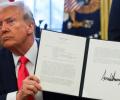
Industry insiders in India warn that any such move in the pharmaceutical sector could be counterproductive for the US as it may face increased drug shortages if tariffs are imposed on such imports.

Concerns over weakening demand for Indian pharmaceutical (pharma) drugs in the US - their largest export market - have weighed heavily on investor sentiment this year. While the Nifty 50 has gained 6.02 per cent year - to - date (as on September 15), the Nifty Pharma index has declined 5.18 per cent, National Stock Exchange data shows.

FDI inflows into India are expected to register robust growth in 2026, supported by strong macroeconomic fundamentals, big-ticket investment announcements, sustained efforts to improve the ease of doing business, and a new generation of investment-linked trade pacts.

Open offers this calendar year, following attempts at acquisition and takeover, came in at more than two a week. There were 121 such open offers to acquire additional shares following a substantial acquisition or change of control, shows the data compiled by primedatabase.com.

'India is clearly moving toward more targeted treatment pathways in high-burden cancers.'

The government on Sunday gave a strong push to upgradation and expansion of healthcare infrastructure, medical education and pharma sector with the Union Budget 2026-27 announcing a slew of steps, including those aimed at making India a global hub for allied healthcare professionals and biopharma manufacturing.

Trump said California has been particularly "hard hit" because of this, blaming democrat Gavin Newsom, the Governor of California, for this loss, calling him "weak and incompetent."

Asia takes the lead, boasting four Indian cities on the list, according to the 2024 Savills Growth Hubs Index.

Bolstered by an impressive performance in the global specialty business and outstanding results in the Indian market, Sun Pharmaceutical Industries, the largest pharmaceutical (pharma) company in the country, showcased a strong performance in the July-September quarter (second quarter, or Q2) of 2023-24 (FY24).

The Congress MP said he had been "troubled" by the US tariff regime from the very beginning, adding that India was already at a disadvantage compared to its regional competitors.

Most pharma shares dropped, dragging the BSE Healthcare index down by 2.14 per cent after Trump's move to impose 100 per cent import tariffs on pharmaceutical drugs from October 1. Wockhardt shares tanked 9.4 per cent.

New Zealand Prime Minister Christopher Luxon on Monday said the negotiations for a free trade agreement with India have been concluded.

According to the Department of Pharmaceuticals' annual report for 2024-25, India imported medical devices worth $8.1 billion, while exports stood at $3.7 billion in the financial year 2023-24 (FY24)

Among the Sensex constituents, Eternal, Trent, Bharti Airtel, Infosys, Tech Mahindra, UltraTech Cement, ICICI Bank, HDFC Bank, Bajaj Finance, Tata Consultancy Services, Bharat Electronics Ltd, Larsen & Toubro and Tata Motors Passenger Vehicles were the laggards. However, Tata Steel, Sun Pharmaceuticals, ITC, NTPC, Reliance Industries, HCL Technologies, PowerGrid, and Asian Paints were among the gainers.

The fiscal tilt towards capex benefits companies in investment-related sectors like capital goods, defence equipment, engineering & construction and metal & mining. The planned cut in revenue expenditure will weigh on companies in consumption sectors like FMCG, consumer durables and retail.
Indian pharmaceutical companies may have units abroad as part of "distributed manufacturing" across various locations, according to industry veterans. This may come about over the next five to 10 years.

Among the Sensex constituents, Eternal, Tata Steel, Kotak Mahindra Bank, UltraTech Cement, Maruti Suzuki India, Sun Pharmaceuticals, Tech Mahindra, HDFC Bank, Tata Motors Passenger Vehicles, Infosys, Trent, Mahindra & Mahindra, Reliance Industries and HCL Technologies were the gainers. However, Asian Paints, Bharti Airtel, Bajaj Finance, PowerGrid, Axis Bank, ICICI Bank and Titan were among the laggards.
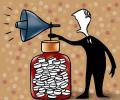
India's healthcare and pharmaceutical sectors raised Rs 14,811 crore through initial public offerings (IPOs) in 2024, the largest since 2019, driven by strong domestic demand amid expanding global opportunities. According to data, key contributors to the record fundraising included Sai Life Sciences (Rs 3,043 crore), IKS Health (Rs 2,498 crore), and Sagility India (Rs 2,107 crore).
The Indian pharmaceutical industry is likely to benefit from a major wave of patent expiries in the US, as small-molecule drugs worth $63.7 billion are expected to go off-patent between 2025-29, a 65 per cent rise over the previous five years, according to a report by Antique stock broking limited.
Next week's three-nation foreign tour of Prime Minister Narendra Modi will see India and Oman sign a free trade deal. The visit will also pave the way for agreements with Ethiopia and Jordan to increase India's bilateral trade and investments.

So far this year, the rupee has fallen by 4.2 per cent, the worst among its Asian peers.

Amid controversy over USPresident Donald Trump's comments linking the use of Tylenol and other related paracetamol products by pregnant women to autism in children, experts and industry executives say that since India's export of the drug to the US is less, it will hardly affect the country's pharma exports to America.

Enhertu currently costs around Rs 1.6 lakh per 100-milligram injection.

From the Sensex pack, Eternal, Bharat Electronics Ltd, Trent, Axis Bank, State Bank of India, Bajaj Finance, Sun Pharmaceuticals, Asian Paints, Adani Ports, Hindustan Unilever, Reliance Industries, ITC, PowerGrid, Tata Motors Ltd's Commercial Vehicles business, and Bajaj Finserv were the gainers. Infosys, Tata Motors Passenger Vehicles, Tata Steel, ICICI Bank, Tech Mahindra, Titan, UltraTech Cement, Maruti Suzuki India, and Larsen & Toubro were the laggards.

Indian drugmakers supply 47 per cent of the generic medicine requirements in the US, and tariffs would have increased prices in the US domestic market for patients, who are already dealing with drug shortages.
